
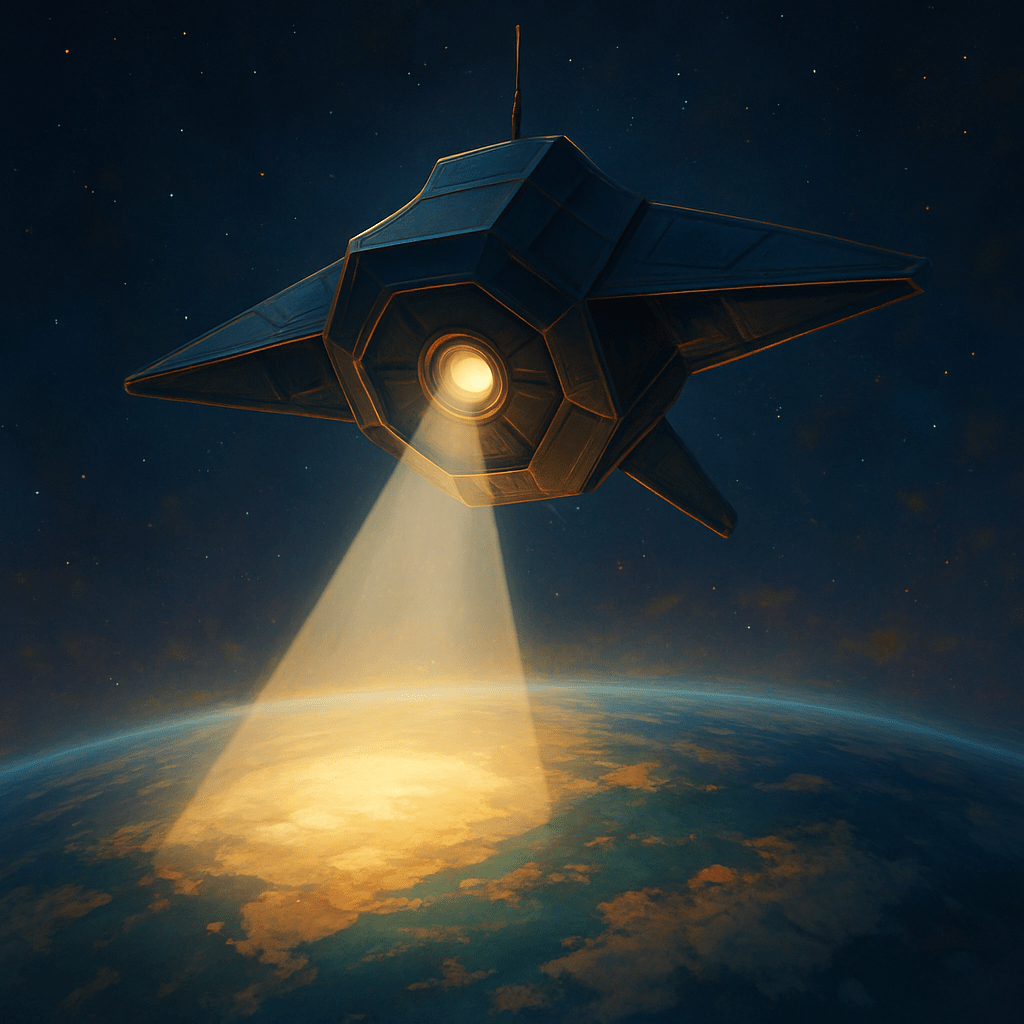
In The Rise of King Asilas, few devices are as consequential—or as philosophically charged—as the Net Ray machine. It is not merely a weapon; it is an argument. An argument about power, about fear, and about the fragility of the systems humanity has relied upon to keep itself in check. The show never reveals the true origins of the Net Ray. We are told only that a mysterious figure known as “Gabriel” helped bring it into existence. This deliberate obscurity elevates the machine beyond a national project or a scientific breakthrough. The Net Ray feels less invented than discovered, as though it were an inevitability waiting for the right moment and the right hands. In this sense, Gabriel functions less as an engineer and more as a midwife to history.
Neutralizing the Ultimate Threat
The Net Ray’s capabilities are deceptively simple. It neutralizes nuclear missiles in midair, causing them to fall harmlessly from the sky by disabling their propulsion systems. There is no explosion, no fiery interception, no spectacle of counterforce. The missile simply ceases to matter. This detail is crucial. The Net Ray does not defeat nuclear weapons through greater violence, but through irrelevance. It strips them of meaning. In doing so, it undermines the philosophical foundation of nuclear deterrence itself: the belief that fear can be stabilized, that terror can be balanced.
Its secondary capability—jamming operating systems, particularly military-grade systems—extends this logic further. Modern warfare is not merely physical; it is informational. By attacking the digital backbone of militaries, the Net Ray severs intention from execution. Orders can no longer guarantee outcomes. Authority dissolves into uncertainty.
For King Asilas, the Net Ray was not simply a strategic advantage—it was a civilizational pivot. The machine ended the era of Mutually Assured Destruction, an era built on a paradoxical faith: that the threat of total annihilation could preserve peace. Once that faith collapsed, so too did the illusion of equality among nations. Nuclear weapons had long functioned as the great equalizer, allowing even smaller or weaker states to demand respect through existential threat. The Net Ray erased that leverage in an instant.
What followed was not global devastation, but global capitulation. Many nations surrendered sovereignty not because they were conquered, but because resistance had lost its rational foundation. When survival depends entirely on the goodwill of a superior power, freedom becomes a luxury ideology cannot afford. Yet the show wisely avoids presenting this as a clean or final resolution. Some nations refused to submit. Deprived of nuclear deterrence, they turned to older, messier forms of resistance—conventional warfare, insurgency, sabotage. The Net Ray ended one logic of war, but it could not end war itself. Conflict, therefore, is not a technological problem.
The Quiet Return of the Same Question in 2026
As we forge into the first quarter of 2026 in the real world, the Net Ray reads less like fantasy and more like allegory. The modern arms race is no longer defined primarily by warheads and delivery systems, but by artificial intelligence. Today, nations compete not just for stronger weapons, but for faster cognition. Within AI circles, the alarm bells are ringing, asserting that the first nation to achieve overwhelming AI supremacy (sometimes loosely framed as a form of “singularity”) will possess an advantage so decisive that traditional military balances may no longer apply.
Such an AI would not need to intercept missiles in the sky. It could prevent them from launching at all. It could predict escalation paths, disrupt command networks, corrupt guidance systems, or paralyze logistics before human decision-makers even comprehend what is happening. Nuclear weapons would remain physically intact, yet strategically hollow.
Here the philosophical parallel becomes unavoidable. How different is such an AI from the Net Ray?
Both eliminate deterrence asymmetrically. Both concentrate power not through destruction, but through negation. And both shift the nature of dominance from visible force to invisible control. The crucial distinction lies in form. The Net Ray is a single machine—centralized, tangible, and therefore symbolically vulnerable. It invites rebellion precisely because it can be imagined, targeted, and mythologized.
AI supremacy, by contrast, would be ambient. It would exist everywhere and nowhere: in models, infrastructure, satellites, and decision pipelines. There would be no throne to storm, no reactor to sabotage. Power would no longer announce itself as power. It would simply feel like the way the world works. This raises an unsettling philosophical question: if domination is subtle enough, does it still feel like domination? Or does it become indistinguishable from order?
The Illusion of Choice
At its core, The Rise of King Asilas is less concerned with tyranny than with inevitability. The Net Ray forces nations into a moral corner where choice exists in theory but not in practice. Submit, or disappear. As AI reshapes global power, the same dilemma may re-emerge under a different name. States may not be conquered, but optimized. Not ruled, but managed. Sovereignty may persist symbolically, even as meaningful autonomy erodes. The Net Ray, then, is not a warning about a single machine. It is a meditation on what happens when technology outpaces the ethical frameworks designed to contain it. It asks whether freedom can survive in a world where resistance is no longer catastrophic, but pointless.
In that sense, the most disturbing aspect of the Net Ray is not what it destroys, but what it makes unnecessary: fear, negotiation, and ultimately, consent.
 The Rise of King Asilas