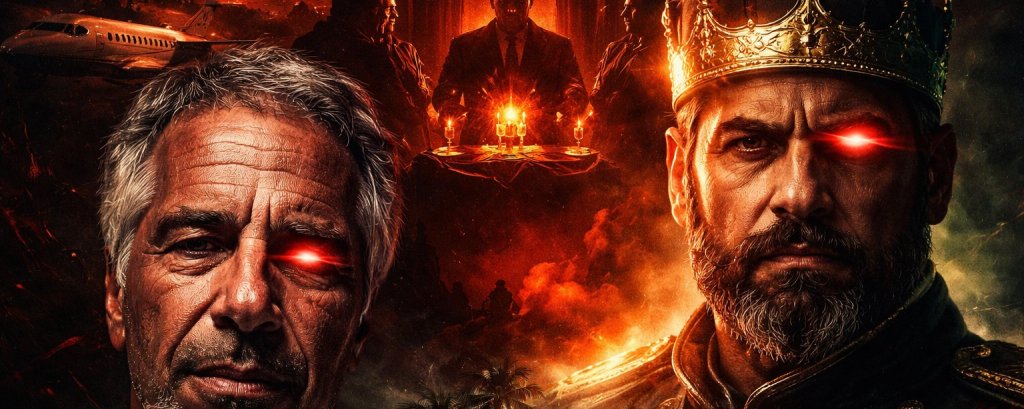
Monsters in the Dark: Episode 3, Hidden Elites, and the Allure of the Epstein Files

In Episode 3, “The Monster Group,” a narrative detonates the core revelation of the series that changes everything. King Asilas confesses that the visible political world is merely theater. Behind its slick exterior stands a concealed fraternity of planners. Standing in the shadows of “dark halls” are evil men, orchestrating leaders, manipulating social tensions, and guiding history like chess pieces. He calls them Monsters. Not their real name, but certainly a fitting one.

For people attuned to real-world intrigue, it is difficult not to feel echoes of modern controversies, especially the public fascination surrounding the “Epstein files.” It begs us to explore why certain patterns in the story feel so compelling to those who enjoy connecting the dots and have followed the show’s storyline. When one listens to episodes (especially in Seasons 1-2), it doesn’t land the same way anymore. The details emerging from the Epstein files have changed how one can truly take in the content of the series.

The Anatomy of the Monster Group

In Episode 3, Asilas admits he once belonged to the secret elite. With so many names redacted, one can surmise that those who claim to “champion” justice are within the orbit of perpetrators named in those files or in the files themselves. Thus, having the fictitious character Asilas also come from within the circle of fiends seems to be in alignment with what is currently coming to light. Ultimately, it cannot be an outsider railing against power; it has to be an insider-turned-defector.

So, let’s explore what the episode suggests. First, political leaders are selected, not elected. Even the simplest of Lehman have long said this out loud, either in jest or blurted intuition. Second, social chaos is engineered. Many conspiracy theorists have been shouting from the hills for decades that the collapse of the Western world is designed to usher in the New World Order. However, the idea that the public is given a curated version of reality isn’t unique to modern society. For as long as civilizations existed, doubt among commoners has persisted when it comes to “believing” what their leaders say outright.

The emotional power of this confession lies in its plausibility. There are no laser beams or alien invasions. At least, not yet. Instead, the horror is bureaucratic (i.e., cigars, exotic drinks, smoky rooms, long discussions about shaping society). The idea that the fate of the world rests in the diabolical plans of a few is unsettling, to say the least. But deep down inside, we know it.

The terror is systemic.

For the conspiracy-minded, this framework feels familiar. Secret meetings. The King and Capone drinking whiskey and planning the death of billions of people. Elite networks. Influence traded in private. The suggestion that what we see is not what is decided.

Listen to Episode 3 (again or for the first time).

The Epstein Files: Catalyst for Suspicion

When documents connected to Jeffrey Epstein and his associates began surfacing publicly through court cases and investigative reporting, the cultural impact was explosive. Names, flight logs, private island references, and redacted files fueled an already simmering suspicion that powerful people operate by different rules. And not just different rules, inhumane and ungodly rules. Some of the information being revealed suggests torture, ritualistic murder, and even cannibalism. It’s disgusting and (for some) completely unbelievable.

Why aren’t people filling the streets with outrage?

Because the situation presented elements that resonate with the “Monster Group” archetype that puts the illusion we’ve all been fed our entire lives on its head. It’s no longer a creepy, horror film or scary campfire story designed to spook the bejesus out of you. It’s starting to set in that this crazy talk is real. And the people engaging in all the “gross stuff” (to quote President Jackson in Season 1) are people we all know very well. They are the wealthy, the rich, and the famous. People we’ve looked up to, people we’ve aspired to be like, people we admired. It’s them, and we want to wake up from this nightmare. But it is true. All of it. And the Epstein files are exposing just how terrifying that secret society truly is. To think: there is still much more we haven’t been shown.

The Psychology of Pattern Recognition

Episode 3 leverages a powerful human instinct: pattern-seeking. Asilas’ analogy about children believing in Santa Claus is pivotal. He argues that society operates under comforting illusions. Once the illusion dissolves, nothing feels stable again. This mirrors how many people describe their reaction to learning about Epstein’s crimes and the elite social circles around him. The idea that wealthy and influential individuals could be entangled in secretive behavior triggers a psychological shift. It invites a broader question:

If this happened, what else could be happening?

That leap is where fiction and speculation thrive.

One of Episode 3’s most compelling elements is Asilas’ transformation. He was not merely aware of the Monster Group; he helped plan its operations. He climbed its ranks. Then he defected. This trope is central to conspiracy culture: the whistleblower. The insider who knows the machinery and chooses to reveal it. In real-world discussions around Epstein, the public has gravitated toward journalists, investigators, and unnamed “sources” who allegedly have deeper knowledge. The idea of someone within the system pulling back the curtain is intoxicating. It satisfies a narrative hunger: redemption through revelation.

The reality, of course, is often far more fragmented and mundane. Legal processes are slow. Evidence is complex. Motives are unclear. But in fiction, clarity is dramatic. A secret society exists. The king knows. The war begins.

“Monsters” as Metaphor

Episode 3 deliberately blurs whether the Monster Group members are metaphorical or literal monsters. Asilas hints that “most of them are not people like you and I.” It could be spiritual symbolism. It could be moral language. Or it could be a literal suggestion within the show’s mythos. Conspiracy theorists frequently adopt similar metaphors in discussing elites. Terms like “monsters,” “demons,” or “reptiles” often function symbolically, expressing perceived moral corruption rather than biological difference.

The language becomes mythic.

And myth is powerful.

The Epstein scandal, while grounded in documented criminal behavior, became mythologized online. Threads spiraled into claims of occult symbolism, ritualistic power structures, and global cabals. But with more details coming to light, with more interpretations and commentary, memes, and TikTok shorts bombarding the masses with images, blacked out faces of literal horror shows, emails with coded, sadistic, and evil messages, our collective heads are spinning. People are going back, reading old blogs and Reddit stories, and literature from Alex Jones.

They all read like a thriller.

The Emotional Core: Betrayal

At its heart, Episode 3 is not about monsters. It is about betrayal. Asilas feels betrayed by the system he served. The audience is meant to feel betrayed by institutions. The Epstein scandal similarly triggered a sense of betrayal. Many citizens asked:

How could this have happened for so long? Who knew? Who looked away?

The mere existence of elite impunity for years created fertile ground for distrust. And distrust is the soil in which conspiracy grows. For those who navigated the dark side of this world, reading fringe, self-published books about the subject of secret societies, and trolling the Internet for breadcrumbs of the cabal on 4chan and other places, the Epstein files are vindication. But no one is celebrating being right about this. Even I, who wrote (arguably) the most epic fiction podcast in the world, there is no glory in being right about this darkness. King Asilas is an archetype, a metaphor, a symbol of a collective scum that dogs humanity’s potential. The bane of achieving peace and prosperity. For in the name of saving humanity, the king ushers in Armageddon and the end of civilization. But none of those happened until King Asilas did one very crucial thing: he hunted those in the Monster Group. And if there is anything that resembles this action in real life, it’s the hunt for those in the infamous Jeffrey Epstein’s client list.

Why These Parallels Fascinate

It is crucial to reiterate: Episode 3 is fiction. The Epstein case, while involving documented crimes and legal proceedings, does not provide verified evidence of a supernatural or unified “Monster Group” controlling governments. But if something smells like excrement, well, there’s only one thing that smells like that. Therefore, the parallels are psychologically compelling and cannot be ignored. Simply put, they reflect archetypes:

  • The hidden council.
  • The compromised elite.
  • The reluctant king who defects.
  • The war against unseen forces.

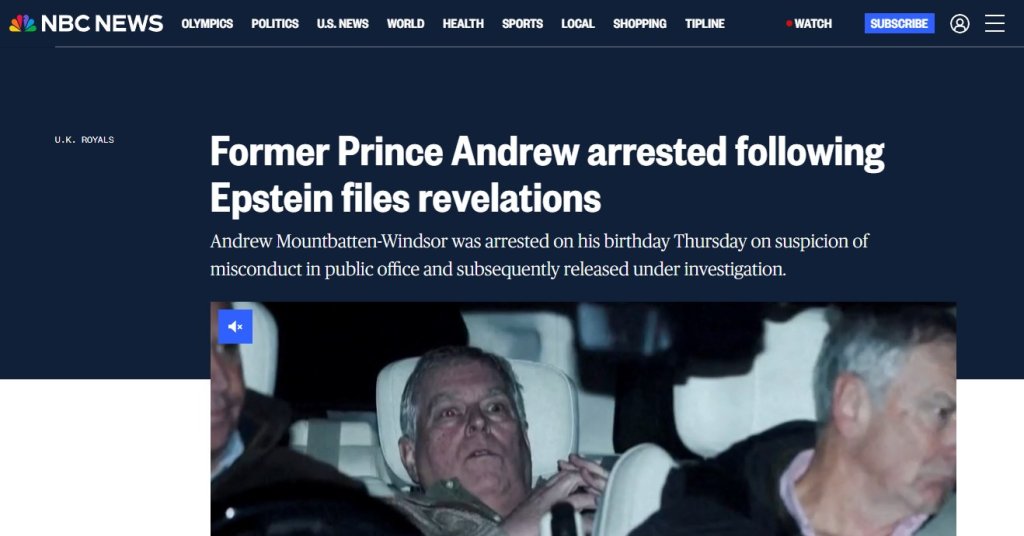
When real-world scandals reveal genuine corruption, they validate the emotional core of these archetypes—even if they do not confirm the grandest interpretations. For conspiracy theorists, the connection is not about proof. It is about pattern resonance. Such as King Asilas’s obsession with hanging the British Royals. And who was arrested on his 66th birthday? The former Prince Andrew.
The Final Question

In Episode 3, Asilas says that learning the truth changes everything. And he’s right. The moment corruption is no longer abstract, no longer rumor, but a documented, undeniable reality, the mind shifts. Certainty fractures. Trust erodes. And in that fracture, something else seeps in.

When people glimpse real corruption, they don’t just become cautious. They become receptive to grand narratives, to hidden architects, to monsters in the dark. The line between vigilance and imagination begins to blur. So what stalks the halls of power? Are there literal monsters pulling strings in secret chambers? Or are there simply flawed human beings—ambitious, afraid, and armed with too much authority?

Reality is rarely as cinematic as fiction. Power is usually more banal than demonic. But in a world saturated with scandal, secrecy, and betrayal, the shadow always feels alive.

And once we believe something is hiding in the dark… we will never stop searching for it.

The AI Reckoning: Humanity’s Future in the Hands of the Few

In Episode 12 of The Rise of King Asilas (The Manifest Destiny), the central question isn’t about power, it’s about sacrifice. When survival hangs by a thread, do you abandon your moral code to secure victory? Or does crossing that line ensure you’ve already lost? It was a moment that resembled that point Caesar “crossed the Rubicon.” There was no going back for King Asilas. The window was closing for him to make his move that would change the world forever. And he wasn’t going to hesitate in that moment.

Now imagine that dilemma… not in a fictional kingdom, but in Silicon Valley boardrooms, classified Pentagon briefings, and quiet diplomatic backchannels between Washington and Beijing. Because today, the same choice is unfolding in the AI arms race. And the terrifying truth? The outcome may not be decided by nations, but by a handful of executives, intelligence officials, and unelected architects of the digital future. All of which facing the same closing window, the same urgency to make their move and change the trajectory of the human race. The stakes are just as high as for the fictional king blowing up Canada’s government. Even higher than what Caesar himself faced when he led his troops across that river and changed the direction of Rome (and essentially the world) forever.

Publicly, artificial intelligence is marketed as productivity tools, chatbots, copilots, and assistants. Privately, insiders speak of something else: strategic dominance. And with those strategies come contingency plans and covert maneuvers to offset blindsided attacks and stay several steps ahead of adversaries. Sound familiar? It should. This is exactly what King Asilas does throughout the series. Behind polished keynotes and quarterly earnings calls, a quiet consolidation of influence has taken shape. A small cluster of technology giants, defense contractors, and national security agencies now sit at the helm of systems that can do everything humans can do any a million times better and faster. This isn’t innovation. It’s leverage. And leverage, in the wrong hands, becomes control.

The Moral Fracture: Speed Over Safeguards

King Asilas’ philosophy, overcome your moral code to survive, now echoes through strategic doctrine. Policy circles increasingly frame AI as a zero-sum contest. Whoever builds the most advanced systems first will set the rules for the next century. Lag behind, and you don’t just lose market share, you lose sovereignty. Organizations like the Council on Foreign Relations openly describe AI as a defining arena of geopolitical rivalry, particularly between the United States and China. The framing is clear: supremacy in AI may determine military dominance, economic command, and global influence for generations.

But here’s the unspoken part.

When leaders believe they are racing against extinction-level disadvantage, ethical hesitation begins to look like weakness. In fact, some AI proponents are believed to be on a suicide mission, risking the entire human race as collateral damage should their gamble turn catastrophic. And most think tanks believe the AI supremacy will lead to global collapse and perhaps the end of humankind as we know it (if not blatant extinction). Is this hyperbole? Could it just be exaggeration? Likely not. Think about King Asilas and his mission: to save humanity. What was the cost? Destruction of global government systems. How was his consolidation of power achieved? His weapons were far superior to those of other countries. And the global system collapsed, one by one until all that was left was King Asilas. And where did he lead the people? To their ultimate fate in Armageddon.

The simple version of the story is “systems were deployed faster than they could be understood.” That was King Asilas’s advantage. By the time the world could react to his weapons, it was already too late. This is the exact same scenario we face (collectively) as a species in the face of this wicked race for AI supremacy. Once the winner shows himself, it will spell doom for all of us on this planet.

The Existential Threshold

The AI Safety Summit at Bletchley Park in 2023 produced the Bletchley Declaration, signed by 28 nations, including the U.S. and China, acknowledging the need for coordinated safeguards. But declarations are not enforcement. Agreements are not guarantees. History shows that when transformative power becomes available, competitive instinct often overrides restraint. Nuclear deterrence created uneasy balance, but AI differs in one critical way:

It can replicate.
It can scale.
It can evolve.

And unlike uranium, its raw material is data, which is something no nation truly controls. The communities of this world have become so dependent on media via the Internet, that the very idea of losing control of those abstracts has some adverse physical consequences. For example, when YouTube ran into some data issues recently and the site went down, within minutes the hashtag #YouTubedown trended like wildfire. It was pandemonium within the hour. Utter panic set in. Anxiety spread. Was this the end? It isn’t even relevant if the event was choreographed or not, the outcome was troublesome. Are people that dependent on media platforms? Absolutely. What would happen if all of them shut down? Honestly, the beginning of the end. Too much of people’s identities are woven into the cyber fabrics of social media that eliminating them would erase people’s brains, their core reason for existence, and chaos would ultimately ensue. It’s kind of like “releasing the fog” and the effects of the Trishul in some sense. Masses of people would blame their leaders and oust them from their state houses. Blood would flood the streets.

And if you think someone holding AI supremacy couldn’t do this with the touch of a button, you are sadly mistaken.

The Concentration Problem

Here’s the part rarely discussed openly: The most advanced AI systems are not evenly distributed across humanity. They are concentrated in a small circle of corporations and government partnerships. Their control is largely overseen by a few executive teams, intelligence committees, and let’s throw in a few classified programs for good measure. Decisions are made about alignment, deployment, safety thresholds, and access is granted to individuals most citizens will never meet, and certainly have never voted for. Yet the decisions made by these select few could determine:

  • Whether labor markets destabilize overnight
  • Whether autonomous weapons become normalized
  • Whether misinformation ecosystems become indistinguishable from reality
  • Whether humanity retains agency over its own technological creations

This is not a democratic process. It is a technocratic inflection point. And to be honest, it would never move forward with any speed if held to the standards of a democratic process. The AI arms race is on and there’s no time to ask the public for their opinions and votes. Such delays would hinder its progress and our enemies would have the advantage. Speed was something King Asilas understood very well in his assault on his enemies. “Waste no time” was something the king often uttered throughout the series. It wasn’t a filler. It wasn’t an irrelevant phrase. It was repeated because time means advantage. The longer it takes you to make a significant move, the more advantage you surrender to your adversaries. This is the mindset of the curators of the AI arms race. It resembles (horrifically) that of the fabled king. And there’s no doubt the outcome would be the same for humanity.

Gabriel’s Warning

Throughout the King Asilas series, Gabriel represents moral resistance. Translated into today’s context, that voice exists among researchers, ethicists, and policy advocates arguing that dominance without guardrails is not strength, it’s systemic fragility. Unchecked AI doesn’t just threaten rivals. It threatens everyone. These threats cannot be brushed off as standard corporate banter or propaganda meant to instill fear in order to assert more control on the masses. A catastrophic failure in one system can ripple globally. A misaligned autonomous defense protocol could escalate conflict unintentionally. A hyper-optimized economic AI could hollow out entire sectors before safeguards respond. And that spells doom. For everyone.

Simply put (in Gabriel’s voice): Victory without virtue becomes self-sabotage. As one listens to the words spoken by these AI pushers, it sounds eerily similar to a mentally ill person on a mission to incinerate an entire city in order to feel warmth. Compassion or reluctance to address the instability of the mentally ill person is signing one’s own death warrant. Avoiding confrontation only ensures the madness will continue with impunity. The masses are as much at fault as the sheep for following the Shepard over the cliff. The warnings are blaring. The picture has been painted. The threat is real. Yet, the world does nothing. And there is no virtue in doing nothing.

The Real Question

The public debate frames AI as progress. The strategic debate frames AI as power. But the deeper question (the one whispered in policy briefings) is this: Are we building tools to empower humanity… Or constructing a cognitive infrastructure so powerful that control inevitably consolidates in the hands of the few who built it? Or worse, consider the possibility it goes into the hands of one man.

History’s empires were limited by geography. Digital empires are limited only by bandwidth. And for the first time, humanity may be approaching a threshold where decision-making power over information, defense, and economics converges into systems overseen by a tiny group of actors operating beyond meaningful public scrutiny. It would be a “High Council” or sorts. But there will always be a head of that council. A head. And on that head, you can bet will be sitting a gold crown.

That is the true dilemma of Episode 12 playing out in real time. Planting bombs inside of Spartans (like AI systems plotting in the dark corners of the Internet), sending them into command centers disguised as someone else (like Trojan horse viruses and malware), destroying everyone in proximity, ushering in a new dominant force, a king. Then, an unfettered absolute authority swoops in to “save the day” and restore order. We know how this ended for the Canadians in Episode 12. And we also know how it ultimately ended for the rest of the world when King Asilas finally revealed what his secret weapon was. The world had to react to something completely new, and something they had no answer for. That concentration of defense took precedence and world leaders could not focus on the man, King Asilas, himself. Who was this man? How did he arrive to wield so much power? And when they stopped to try and reason with him, it was already too late. Their only choice by that time was to kneel before their new ruler, whether they liked it or not. The loss of privacy, then the loss of sovereignty. They had lost the game before they sat down at the chess board. The absolute authority of King Asilas was a consolidation of access. They couldn’t even make a move, at least not without permission. Think about that.But the road to societal collapse (although brutal and bloody) took more than mere technological (and military) superiority. There were other forces at work, if you recall the characters of the series. Reptilians, cannibals, and occult entities are infused throughout the entire storyline. If the Epstein files has shown us anything in these recent weeks, it’s that The Rise of King Asilas feels less like fiction in 2026.

The Net Ray and the End of Nuclear Sovereignty

An AI rendition of what the Net Ray may look like based on its description in the show.

In The Rise of King Asilas, few devices are as consequential—or as philosophically charged—as the Net Ray machine. It is not merely a weapon; it is an argument. An argument about power, about fear, and about the fragility of the systems humanity has relied upon to keep itself in check. The show never reveals the true origins of the Net Ray. We are told only that a mysterious figure known as “Gabriel” helped bring it into existence. This deliberate obscurity elevates the machine beyond a national project or a scientific breakthrough. The Net Ray feels less invented than discovered, as though it were an inevitability waiting for the right moment and the right hands. In this sense, Gabriel functions less as an engineer and more as a midwife to history.

Neutralizing the Ultimate Threat

The Net Ray’s capabilities are deceptively simple. It neutralizes nuclear missiles in midair, causing them to fall harmlessly from the sky by disabling their propulsion systems. There is no explosion, no fiery interception, no spectacle of counterforce. The missile simply ceases to matter. This detail is crucial. The Net Ray does not defeat nuclear weapons through greater violence, but through irrelevance. It strips them of meaning. In doing so, it undermines the philosophical foundation of nuclear deterrence itself: the belief that fear can be stabilized, that terror can be balanced.

Its secondary capability—jamming operating systems, particularly military-grade systems—extends this logic further. Modern warfare is not merely physical; it is informational. By attacking the digital backbone of militaries, the Net Ray severs intention from execution. Orders can no longer guarantee outcomes. Authority dissolves into uncertainty.

For King Asilas, the Net Ray was not simply a strategic advantage—it was a civilizational pivot. The machine ended the era of Mutually Assured Destruction, an era built on a paradoxical faith: that the threat of total annihilation could preserve peace. Once that faith collapsed, so too did the illusion of equality among nations. Nuclear weapons had long functioned as the great equalizer, allowing even smaller or weaker states to demand respect through existential threat. The Net Ray erased that leverage in an instant.

What followed was not global devastation, but global capitulation. Many nations surrendered sovereignty not because they were conquered, but because resistance had lost its rational foundation. When survival depends entirely on the goodwill of a superior power, freedom becomes a luxury ideology cannot afford. Yet the show wisely avoids presenting this as a clean or final resolution. Some nations refused to submit. Deprived of nuclear deterrence, they turned to older, messier forms of resistance—conventional warfare, insurgency, sabotage. The Net Ray ended one logic of war, but it could not end war itself. Conflict, therefore, is not a technological problem.

The Quiet Return of the Same Question in 2026

As we forge into the first quarter of 2026 in the real world, the Net Ray reads less like fantasy and more like allegory. The modern arms race is no longer defined primarily by warheads and delivery systems, but by artificial intelligence. Today, nations compete not just for stronger weapons, but for faster cognition. Within AI circles, the alarm bells are ringing, asserting that the first nation to achieve overwhelming AI supremacy (sometimes loosely framed as a form of “singularity”) will possess an advantage so decisive that traditional military balances may no longer apply.

Such an AI would not need to intercept missiles in the sky. It could prevent them from launching at all. It could predict escalation paths, disrupt command networks, corrupt guidance systems, or paralyze logistics before human decision-makers even comprehend what is happening. Nuclear weapons would remain physically intact, yet strategically hollow.

Here the philosophical parallel becomes unavoidable. How different is such an AI from the Net Ray?

Both eliminate deterrence asymmetrically. Both concentrate power not through destruction, but through negation. And both shift the nature of dominance from visible force to invisible control. The crucial distinction lies in form. The Net Ray is a single machine—centralized, tangible, and therefore symbolically vulnerable. It invites rebellion precisely because it can be imagined, targeted, and mythologized.

AI supremacy, by contrast, would be ambient. It would exist everywhere and nowhere: in models, infrastructure, satellites, and decision pipelines. There would be no throne to storm, no reactor to sabotage. Power would no longer announce itself as power. It would simply feel like the way the world works. This raises an unsettling philosophical question: if domination is subtle enough, does it still feel like domination? Or does it become indistinguishable from order?

The Illusion of Choice

At its core, The Rise of King Asilas is less concerned with tyranny than with inevitability. The Net Ray forces nations into a moral corner where choice exists in theory but not in practice. Submit, or disappear. As AI reshapes global power, the same dilemma may re-emerge under a different name. States may not be conquered, but optimized. Not ruled, but managed. Sovereignty may persist symbolically, even as meaningful autonomy erodes. The Net Ray, then, is not a warning about a single machine. It is a meditation on what happens when technology outpaces the ethical frameworks designed to contain it. It asks whether freedom can survive in a world where resistance is no longer catastrophic, but pointless.

In that sense, the most disturbing aspect of the Net Ray is not what it destroys, but what it makes unnecessary: fear, negotiation, and ultimately, consent.

King Asilas Update: The Path to “Eviscerate” and Beyond

Greetings, citizens of the New Kingdom of America.

Many of you have been wondering about the release of Eviscerate, the long-awaited film adaptation of the King Asilas saga. I want to take a moment to share where things stand and what’s coming next. Over the past months, I’ve been reworking key scenes using advanced A.I. tools to achieve a far more cinematic and immersive experience. This process has opened new creative doors, allowing me to expand the story in ways that were previously impossible. With A.I.-enhanced visuals and faster production workflows, the world of King Asilas is about to grow even more epic and visually stunning.

This does mean the release of Eviscerate will take a bit longer, but it’s for the best reason imaginable. The film is evolving into something larger, something that will set the tone for what’s to come in 2026 and beyond. Expect new storylines, deeper lore, and a visual experience worthy of the King himself. In the meantime, fans of the written word can dive into Ouroboros, the latest installment in the King Asilas universe — now available in hardcover just in time for the holiday season. Orders placed soon will ensure delivery before Christmas, making it the perfect gift for any fan of the New Kingdom of America. Here’s what one recent reviewer had to say:

“Ouroboros captures the dark brilliance of Asilas’ world while pushing the boundaries of storytelling. It’s bold, haunting, and unforgettable.”

Thank you all for your patience, support, and continued loyalty to King Asilas. The best is yet to come. If you really want to have some fun in the meantime, go to Grok or ChatGPT and ask it to give you a breakdown of the Rise of King Asilas. It’ll blow you away. And, oh yeah, the Lost Episodes have begun on our Patreon. Sign up and get the latest.

— JV Torres
Creator of The Rise of King Asilas

First King Asilas Novel Book Launch

JV Torres, creator of The Rise of King Asilas, has published the first novel based on the epic fiction podcast titled “The Ouroboros.” The book is available on Amazon in both paperback and ebook. Also, there will be an official launch party in Baltimore on November 16, 2023 at 6PM at the Hillsmere restaurant (5707 Belair Road, Baltimore, MD). Some cast members from the podcast will be there mingling with fans and spectators, so it is sure to be a fun event. If you can’t make the event, you can still show your support by getting a copy of the novel by clicking HERE. Also, check out the flyer for the event.