The Net Ray and the End of Nuclear Sovereignty

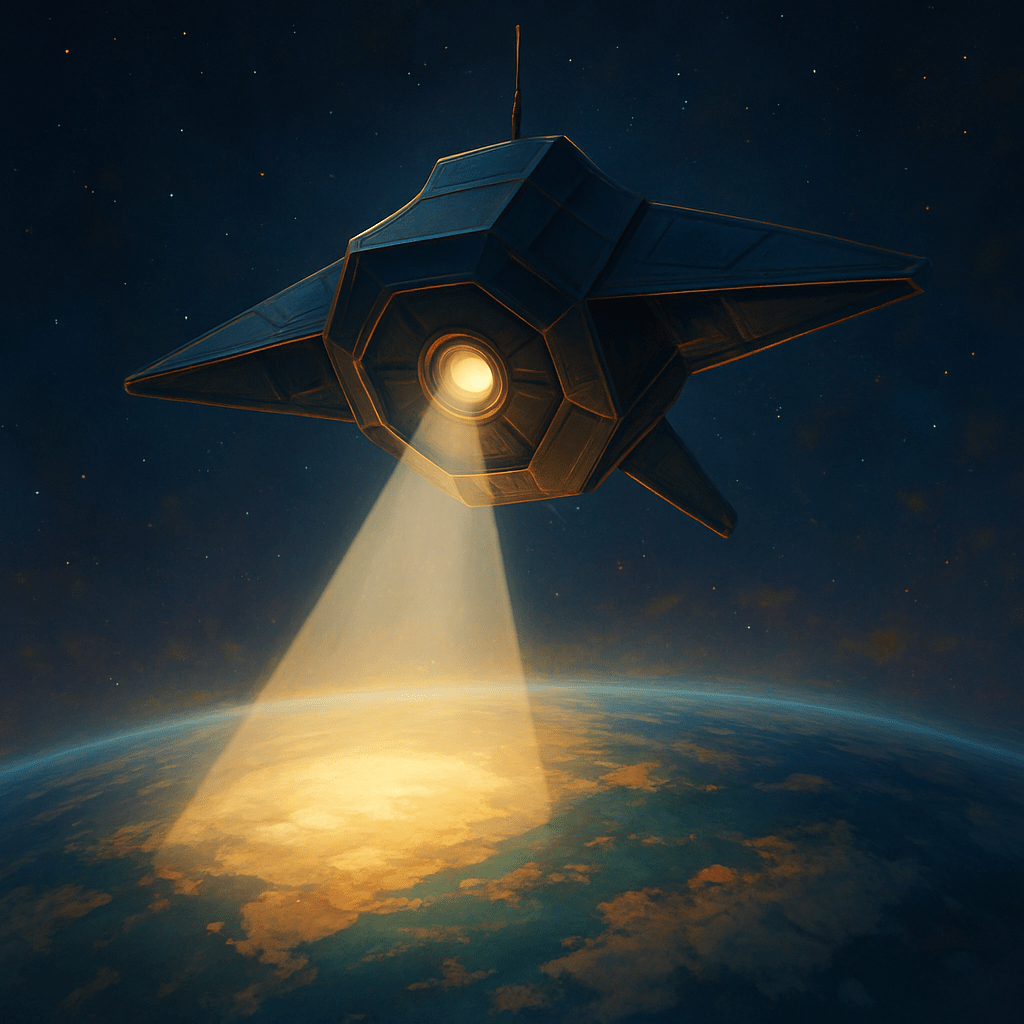
An AI rendition of what the Net Ray may look like based on its description in the show.

In The Rise of King Asilas, few devices are as consequential—or as philosophically charged—as the Net Ray machine. It is not merely a weapon; it is an argument. An argument about power, about fear, and about the fragility of the systems humanity has relied upon to keep itself in check. The show never reveals the true origins of the Net Ray. We are told only that a mysterious figure known as “Gabriel” helped bring it into existence. This deliberate obscurity elevates the machine beyond a national project or a scientific breakthrough. The Net Ray feels less invented than discovered, as though it were an inevitability waiting for the right moment and the right hands. In this sense, Gabriel functions less as an engineer and more as a midwife to history.

Neutralizing the Ultimate Threat

The Net Ray’s capabilities are deceptively simple. It neutralizes nuclear missiles in midair, causing them to fall harmlessly from the sky by disabling their propulsion systems. There is no explosion, no fiery interception, no spectacle of counterforce. The missile simply ceases to matter. This detail is crucial. The Net Ray does not defeat nuclear weapons through greater violence, but through irrelevance. It strips them of meaning. In doing so, it undermines the philosophical foundation of nuclear deterrence itself: the belief that fear can be stabilized, that terror can be balanced.

Its secondary capability—jamming operating systems, particularly military-grade systems—extends this logic further. Modern warfare is not merely physical; it is informational. By attacking the digital backbone of militaries, the Net Ray severs intention from execution. Orders can no longer guarantee outcomes. Authority dissolves into uncertainty.

For King Asilas, the Net Ray was not simply a strategic advantage—it was a civilizational pivot. The machine ended the era of Mutually Assured Destruction, an era built on a paradoxical faith: that the threat of total annihilation could preserve peace. Once that faith collapsed, so too did the illusion of equality among nations. Nuclear weapons had long functioned as the great equalizer, allowing even smaller or weaker states to demand respect through existential threat. The Net Ray erased that leverage in an instant.

What followed was not global devastation, but global capitulation. Many nations surrendered sovereignty not because they were conquered, but because resistance had lost its rational foundation. When survival depends entirely on the goodwill of a superior power, freedom becomes a luxury ideology cannot afford. Yet the show wisely avoids presenting this as a clean or final resolution. Some nations refused to submit. Deprived of nuclear deterrence, they turned to older, messier forms of resistance—conventional warfare, insurgency, sabotage. The Net Ray ended one logic of war, but it could not end war itself. Conflict, therefore, is not a technological problem.

The Quiet Return of the Same Question in 2026

As we forge into the first quarter of 2026 in the real world, the Net Ray reads less like fantasy and more like allegory. The modern arms race is no longer defined primarily by warheads and delivery systems, but by artificial intelligence. Today, nations compete not just for stronger weapons, but for faster cognition. Within AI circles, the alarm bells are ringing, asserting that the first nation to achieve overwhelming AI supremacy (sometimes loosely framed as a form of “singularity”) will possess an advantage so decisive that traditional military balances may no longer apply.

Such an AI would not need to intercept missiles in the sky. It could prevent them from launching at all. It could predict escalation paths, disrupt command networks, corrupt guidance systems, or paralyze logistics before human decision-makers even comprehend what is happening. Nuclear weapons would remain physically intact, yet strategically hollow.

Here the philosophical parallel becomes unavoidable. How different is such an AI from the Net Ray?

Both eliminate deterrence asymmetrically. Both concentrate power not through destruction, but through negation. And both shift the nature of dominance from visible force to invisible control. The crucial distinction lies in form. The Net Ray is a single machine—centralized, tangible, and therefore symbolically vulnerable. It invites rebellion precisely because it can be imagined, targeted, and mythologized.

AI supremacy, by contrast, would be ambient. It would exist everywhere and nowhere: in models, infrastructure, satellites, and decision pipelines. There would be no throne to storm, no reactor to sabotage. Power would no longer announce itself as power. It would simply feel like the way the world works. This raises an unsettling philosophical question: if domination is subtle enough, does it still feel like domination? Or does it become indistinguishable from order?

The Illusion of Choice

At its core, The Rise of King Asilas is less concerned with tyranny than with inevitability. The Net Ray forces nations into a moral corner where choice exists in theory but not in practice. Submit, or disappear. As AI reshapes global power, the same dilemma may re-emerge under a different name. States may not be conquered, but optimized. Not ruled, but managed. Sovereignty may persist symbolically, even as meaningful autonomy erodes. The Net Ray, then, is not a warning about a single machine. It is a meditation on what happens when technology outpaces the ethical frameworks designed to contain it. It asks whether freedom can survive in a world where resistance is no longer catastrophic, but pointless.

In that sense, the most disturbing aspect of the Net Ray is not what it destroys, but what it makes unnecessary: fear, negotiation, and ultimately, consent.

King Asilas Update: The Path to “Eviscerate” and Beyond

Greetings, citizens of the New Kingdom of America.

Many of you have been wondering about the release of Eviscerate, the long-awaited film adaptation of the King Asilas saga. I want to take a moment to share where things stand and what’s coming next. Over the past months, I’ve been reworking key scenes using advanced A.I. tools to achieve a far more cinematic and immersive experience. This process has opened new creative doors, allowing me to expand the story in ways that were previously impossible. With A.I.-enhanced visuals and faster production workflows, the world of King Asilas is about to grow even more epic and visually stunning.

This does mean the release of Eviscerate will take a bit longer, but it’s for the best reason imaginable. The film is evolving into something larger, something that will set the tone for what’s to come in 2026 and beyond. Expect new storylines, deeper lore, and a visual experience worthy of the King himself. In the meantime, fans of the written word can dive into Ouroboros, the latest installment in the King Asilas universe — now available in hardcover just in time for the holiday season. Orders placed soon will ensure delivery before Christmas, making it the perfect gift for any fan of the New Kingdom of America. Here’s what one recent reviewer had to say:

“Ouroboros captures the dark brilliance of Asilas’ world while pushing the boundaries of storytelling. It’s bold, haunting, and unforgettable.”

Thank you all for your patience, support, and continued loyalty to King Asilas. The best is yet to come. If you really want to have some fun in the meantime, go to Grok or ChatGPT and ask it to give you a breakdown of the Rise of King Asilas. It’ll blow you away. And, oh yeah, the Lost Episodes have begun on our Patreon. Sign up and get the latest.

— JV Torres
Creator of The Rise of King Asilas

Abigail: The Princess of a Princess

“Asilas was involved in black ops government projects that crossbred humans with the alien Drax race to produce hybrid humanoids that could survive in the realm of the Drax and essentially be blood factories.”

Abigail Sierra was on track to become the most powerful Spartan in Asilas’s army. So powerful, in fact, that she could have been the one to overthrow Asilas himself. He figured this out through a series of dreams, omens, and probing the young girl’s mind over the course of her training as a Spartan soldier. He forgo his plans to make her the premier Knight Spartan and savior of humanity –even as he held out hope she would change her perspectives and align herself with spiritual philosophies he subscribed to. However, she never showed any interest in religion and was too headstrong to be convinced there was a divine being, a God, a creator, and overseer of humankind, and thus she limited herself in particular areas of training that involved heightened consciousness and awareness in the universe. Abigail never wanted to be a “believer” in God or divine creation, and no amount of discourse with the king would or could change her mind.

Asilas’s plans for Abigail began from her birth. Her conception was part of a secret hybrid project that began long before Asilas became king. As a General in the army and a high ranking member of the Ordo, a very secret and powerful group of elitists that participated in occult rituals, Asilas stood with members of the Ordo as representatives of mankind as they hashed out alliances with alien races and manipulated governments around the world. Asilas was involved in black ops government projects that crossbred humans with the alien Drax race to produce hybrid humanoids that could survive in the realm of the Drax and essentially be “blood factories.” The Drax never paid much mind to Asilas, as he was seen as merely a human slave. However, some in the hierarchy of the Ordo were not immune to his abilities or persuasion and, over time, he was able to use his secret abilities to smuggle hybrid babies out of underground laboratories dotted around the United States. Each hybrid baby had human and Drax DNA, but were essentially human. The hybrids would later become his Spartan army because they were immensely more powerful both physically and mentally than pure humans. Asilas had a partner in this scheme –his former army comrade Quintin Capone, who had become a high ranking administrator in the New York City Public School System and eventually became its Chancellor. Capone used his position in the school system to place these hybrid children in schools with foster parents who were paid a monthly stipend to care for them and raise them as their own children.

The Lemuria Connection

Abigail was different than any other Spartan soldier. Her Drax DNA did not come from a Drax warrior; it came from Lemuria, a princess of the Drax High Order. Lemuria was the most powerful Drax on planet earth. Her Drax Lords seldom ventured to earth and preferred to reside in other interdimensional domains –leaving Lemuria as the sole ruler in the human domain. Lemuria used her own DNA to create clones of a special Drax warrior named “Russel” and created an elite guard to protect her while she dwelled on earth after the death of the Drax prince who proceeded her. With her DNA in the Russel clones, she could not only control each one, she could sense everything they sensed –so long she was within 99 miles of any of them.

Fortunately for Asilas and Abigail, Lemuria and the Drax tended to stay in cold regions, such as the northern and southern poles ,and remained as far from human activity as possible. Asilas was assigned to oversee the Drax elite guard cloning project out of sheer chance and had access to Lemuria’s DNA samples. He smuggled one sample out and created one hybrid baby from it. That baby was Abigail.

This was one of the reasons Abigail’s limitations frustrated Asilas to the point of exhaustion. Although he knew she held the key to become the greatest Spartan warrior on the entire planet, he also knew her unwillingness to receive God into her heart made her vulnerable to corruption and essentially make her a danger to his reign. In his original plans, Abigail would have lead the American Alliance to battle with the Drax after all nations on earth aligned with America for the Great Revolution and ultimately free humanity from the grip of the Monster Group. The only way Abigail would be able to remain strong enough to resist all temptations was to have a strong faith in God. This was how Asilas figured she could combat Lemuria’s control once she met the Drax on the battlefield. However, since she never accepted the notion of God, she would have eventually been commandeered by Lemuria and turn against America.

Abigail was merely a teenager when she began her training as a Spartan. From the onset, she demonstrated superior power over all other cadets. Asilas and Capone kept a very close eye on her development and determined Abigail would mature to become powerful enough to defeat whole platoons of Drax warriors. Her lack of spiritual enlightenment, however, sealed her doom and Asilas used his Ace card to destroy the Canadian government instead. She would naturally become too dangerous to him. The king mourned Abigail when she died in Ottawa, not so much because of his love for the girl, but because a major play in his master plan had to be scrapped. He reluctantly sent Abigail to her death prematurely simply because he had no other choice. This disruption in his plans presented a significant challenge and left a major void for the king and America’s Great Revolution that would come to an explosive eventuality in mankind’s greatest test in Antarctica.

Listen to Abigail’s final moments in season one’s finale.

Lemuria and the Drax High Order

The Drax were the most dangerous entities on earth and had been the secret human masters for thousands of years. Although Asilas was well aware of the Drax long before he was chosen by them to be King of America, there was much about them and their hierarchical system he simply did not know. As a member of The Ordo, Asilas had access to some of the most incredibly fascinating and horrifying realities about a system designed to keep human beings occupied with trivial matters and never seek to heighten their awareness or consciousness. If humans ever realized the true power of their minds, the Drax would never have been able to control them. Asilas knew this and was able to mask his true heart and intentions as he raised to the highest levels of The Ordo.


Lemuria was a Princess of the Drax High Order. Her role was to oversee and manage the affairs of people and delegate their human surrogates to create chaos, engage in senseless wars, use the military complex to develop high-tech machines of various types as disruptive apparatuses to manipulate mankind –even using weather modification technologies to keep humans in a constant state of fear. Lemuria, for all her thorough inclinations, was not a military strategist. It was never necessary for her to be this. However, when facing King Asilas and the encroaching American Allied forces, Lemuria would not heed any warnings from her advisors –not even from the Devil himself. She wanted to resolve the matter of ridding the world of Asilas on her own and take her victory back to the Drax High Order and stake her rightful claim to the line of succession and realize her ultimate goal of becoming the Queen of the Drax.


In King Asilas’s Revolution, there was one thing that was not quite clear: Why were the Drax not attacking humans out in the open? Asilas had hoped the taking of Europe, England and Africa would surely make the Drax face the American military in an open battlefield. He needed this to happen so the entire world would finally align with him and America. However, Lemuria continued to order the Drax to stay out of sight, as she was also aware of Asilas’s goal of uniting the world in his campaign to fight them. She did not want to make that unification happen easily for Asilas and decided to wait until he would have no choice but to fight them on their terms. This would ultimately lead Asilas’s Revolution to the ends of the earth –to the ultimate showdown between man and beast in the most inhospitable place on the face of the planet…Antarctica.


Lemuria believed if she stood her ground, the Drax warriors would destroy the human army. If successful, she would be hailed as the greatest Drax Princess in modern times and would surely be in line to be the next ruler of the Drax race. Her Drax warriors were the most insidious and powerful creatures this world had ever known, and it would take all of Asilas’s best military strategies to have a chance to win his Revolution and free humanity from their ultimate masters. Lemuria would defy even her most trusted and battle tested generals in her desire to defeat the American King in an epic war that would change the course of humanity for a thousand years. However, Asilas would lead his army into the belly of the beast and orchestrate the most dramatic assault the Drax had ever encountered.

The Importance of Quintin Capone

King Asilas is not a man who needs reassurances about the decisions he makes. He is the quintessential leader and does not rest until he completes his mission, and reflects on the costs once his objective is achieved. Which has mustered curiosity by some as to why Quintin Capone is such an important figure in Asilas’s inner circle. The easiest analogy to use when evaluating the situation and the people surrounding the king is the classic game of chess. The king has two bishops, two knights, two rooks, a queen, and two lines of pawns. By episode 4, we already know his queen and who his two bishops are: Quintin Capone and Dr. Ezekiel. These men give the king guidance and he trusts their points of view. Minister Jeremy Oreb falls into the category of a knight because Asilas sends him to meet combatants, terrorists, domestic rebels and other threats with the might of his guns.  President Jackson is a rook because he proves to be valuable to the king in terms of public opinion. He also maintains ties to the monster group. We also know who some of his pawns are: Abigail Sierra and Rachel Canaan, but Rachel was likely sacrificed in episode 4. When you look at the characters in the show through this lens, you begin to see how their maneuvering is determined. Each move is calculated with another anticipated by the king.

But how did Quintin Capone, a school chancellor for New York City Public Schools during the second civil war, become the most powerful “right-hand man” of the New Kingdom? The show does not give any clues as to how Capone became so trusted by Asilas. The novel does explain this in detail. Capone was once in the Army and served alongside of Asilas in their early years. Asilas ascended in rank and Capone left the Army due to an injury. They remained friends and stayed in touch over the years. To sum it up, during the war, the United States was in utter chaos -with battlefronts scattered across the entire country. The one place where the civil war was not felt so disruptively was New York City. School children continued to go to school and life was as normal as it could have been during such a tumultuous time. The establishment of Marshall Law at the conclusion of the war by General Asilas enabled school systems to be community hubs for dissemination of information, instructions, basic first aid, and a plethora of social services so people would not have to venture far from their homes during the transitionary period. In a large city like New York, this emergency system kept the enormous population from plunging into utter turmoil. Capone, along with the mayor, reassured everyone life can continue as normal as long as they followed the instructions given by Washington and General Asilas. While cities like Seattle, San Francisco and Los Angeles experienced great upheaval by a restless and paranoid population, New York was largely controlled and managed to stay peaceful during the government transition period. This decorum by New Yorkers on such a vast scale did not go unnoticed by Capone’s old friend, General Asilas.

When Asilas became king, the first person he asked to join his circle was Quintin Capone. For most, he was an enigmatic figure, but New Yorkers and people in the education field on the east coast knew Capone quite well. He was feared and despised by some, but respected by all. No one wished to cross him professionally or personally. So, to those who knew Capone, they were not nearly surprised to learn he would sit at the right hand of the king. The two men were very like-minded and always seemed to accomplish whatever they put their minds to. Their love and admiration for one another is evident in the way they converse. Capone, a brilliant man in his own right, was too smart to question the king when he knew his mind was made up. And whenever he spoke in contrast to the king’s ideas, he knew it to be wise to bow figuratively and literally. However, Asilas had no siblings and was not very close to many in his family since his days in the Army and Capone became his surrogate brother. He loved Capone for the figurative “brother” he was to him. But in the game of chess, Capone was his bishop and would sacrifice him only if absolutely necessary and only if he knew it would help him win the game.