The AI Reckoning: Humanity’s Future in the Hands of the Few

In Episode 12 of The Rise of King Asilas (The Manifest Destiny), the central question isn’t about power, it’s about sacrifice. When survival hangs by a thread, do you abandon your moral code to secure victory? Or does crossing that line ensure you’ve already lost? It was a moment that resembled that point Caesar “crossed the Rubicon.” There was no going back for King Asilas. The window was closing for him to make his move that would change the world forever. And he wasn’t going to hesitate in that moment.

Now imagine that dilemma… not in a fictional kingdom, but in Silicon Valley boardrooms, classified Pentagon briefings, and quiet diplomatic backchannels between Washington and Beijing. Because today, the same choice is unfolding in the AI arms race. And the terrifying truth? The outcome may not be decided by nations, but by a handful of executives, intelligence officials, and unelected architects of the digital future. All of which facing the same closing window, the same urgency to make their move and change the trajectory of the human race. The stakes are just as high as for the fictional king blowing up Canada’s government. Even higher than what Caesar himself faced when he led his troops across that river and changed the direction of Rome (and essentially the world) forever.

Publicly, artificial intelligence is marketed as productivity tools, chatbots, copilots, and assistants. Privately, insiders speak of something else: strategic dominance. And with those strategies come contingency plans and covert maneuvers to offset blindsided attacks and stay several steps ahead of adversaries. Sound familiar? It should. This is exactly what King Asilas does throughout the series. Behind polished keynotes and quarterly earnings calls, a quiet consolidation of influence has taken shape. A small cluster of technology giants, defense contractors, and national security agencies now sit at the helm of systems that can do everything humans can do any a million times better and faster. This isn’t innovation. It’s leverage. And leverage, in the wrong hands, becomes control.

The Moral Fracture: Speed Over Safeguards

King Asilas’ philosophy, overcome your moral code to survive, now echoes through strategic doctrine. Policy circles increasingly frame AI as a zero-sum contest. Whoever builds the most advanced systems first will set the rules for the next century. Lag behind, and you don’t just lose market share, you lose sovereignty. Organizations like the Council on Foreign Relations openly describe AI as a defining arena of geopolitical rivalry, particularly between the United States and China. The framing is clear: supremacy in AI may determine military dominance, economic command, and global influence for generations.

But here’s the unspoken part.

When leaders believe they are racing against extinction-level disadvantage, ethical hesitation begins to look like weakness. In fact, some AI proponents are believed to be on a suicide mission, risking the entire human race as collateral damage should their gamble turn catastrophic. And most think tanks believe the AI supremacy will lead to global collapse and perhaps the end of humankind as we know it (if not blatant extinction). Is this hyperbole? Could it just be exaggeration? Likely not. Think about King Asilas and his mission: to save humanity. What was the cost? Destruction of global government systems. How was his consolidation of power achieved? His weapons were far superior to those of other countries. And the global system collapsed, one by one until all that was left was King Asilas. And where did he lead the people? To their ultimate fate in Armageddon.

The simple version of the story is “systems were deployed faster than they could be understood.” That was King Asilas’s advantage. By the time the world could react to his weapons, it was already too late. This is the exact same scenario we face (collectively) as a species in the face of this wicked race for AI supremacy. Once the winner shows himself, it will spell doom for all of us on this planet.

The Existential Threshold

The AI Safety Summit at Bletchley Park in 2023 produced the Bletchley Declaration, signed by 28 nations, including the U.S. and China, acknowledging the need for coordinated safeguards. But declarations are not enforcement. Agreements are not guarantees. History shows that when transformative power becomes available, competitive instinct often overrides restraint. Nuclear deterrence created uneasy balance, but AI differs in one critical way:

It can replicate.
It can scale.
It can evolve.

And unlike uranium, its raw material is data, which is something no nation truly controls. The communities of this world have become so dependent on media via the Internet, that the very idea of losing control of those abstracts has some adverse physical consequences. For example, when YouTube ran into some data issues recently and the site went down, within minutes the hashtag #YouTubedown trended like wildfire. It was pandemonium within the hour. Utter panic set in. Anxiety spread. Was this the end? It isn’t even relevant if the event was choreographed or not, the outcome was troublesome. Are people that dependent on media platforms? Absolutely. What would happen if all of them shut down? Honestly, the beginning of the end. Too much of people’s identities are woven into the cyber fabrics of social media that eliminating them would erase people’s brains, their core reason for existence, and chaos would ultimately ensue. It’s kind of like “releasing the fog” and the effects of the Trishul in some sense. Masses of people would blame their leaders and oust them from their state houses. Blood would flood the streets.

And if you think someone holding AI supremacy couldn’t do this with the touch of a button, you are sadly mistaken.

The Concentration Problem

Here’s the part rarely discussed openly: The most advanced AI systems are not evenly distributed across humanity. They are concentrated in a small circle of corporations and government partnerships. Their control is largely overseen by a few executive teams, intelligence committees, and let’s throw in a few classified programs for good measure. Decisions are made about alignment, deployment, safety thresholds, and access is granted to individuals most citizens will never meet, and certainly have never voted for. Yet the decisions made by these select few could determine:

  • Whether labor markets destabilize overnight
  • Whether autonomous weapons become normalized
  • Whether misinformation ecosystems become indistinguishable from reality
  • Whether humanity retains agency over its own technological creations

This is not a democratic process. It is a technocratic inflection point. And to be honest, it would never move forward with any speed if held to the standards of a democratic process. The AI arms race is on and there’s no time to ask the public for their opinions and votes. Such delays would hinder its progress and our enemies would have the advantage. Speed was something King Asilas understood very well in his assault on his enemies. “Waste no time” was something the king often uttered throughout the series. It wasn’t a filler. It wasn’t an irrelevant phrase. It was repeated because time means advantage. The longer it takes you to make a significant move, the more advantage you surrender to your adversaries. This is the mindset of the curators of the AI arms race. It resembles (horrifically) that of the fabled king. And there’s no doubt the outcome would be the same for humanity.

Gabriel’s Warning

Throughout the King Asilas series, Gabriel represents moral resistance. Translated into today’s context, that voice exists among researchers, ethicists, and policy advocates arguing that dominance without guardrails is not strength, it’s systemic fragility. Unchecked AI doesn’t just threaten rivals. It threatens everyone. These threats cannot be brushed off as standard corporate banter or propaganda meant to instill fear in order to assert more control on the masses. A catastrophic failure in one system can ripple globally. A misaligned autonomous defense protocol could escalate conflict unintentionally. A hyper-optimized economic AI could hollow out entire sectors before safeguards respond. And that spells doom. For everyone.

Simply put (in Gabriel’s voice): Victory without virtue becomes self-sabotage. As one listens to the words spoken by these AI pushers, it sounds eerily similar to a mentally ill person on a mission to incinerate an entire city in order to feel warmth. Compassion or reluctance to address the instability of the mentally ill person is signing one’s own death warrant. Avoiding confrontation only ensures the madness will continue with impunity. The masses are as much at fault as the sheep for following the Shepard over the cliff. The warnings are blaring. The picture has been painted. The threat is real. Yet, the world does nothing. And there is no virtue in doing nothing.

The Real Question

The public debate frames AI as progress. The strategic debate frames AI as power. But the deeper question (the one whispered in policy briefings) is this: Are we building tools to empower humanity… Or constructing a cognitive infrastructure so powerful that control inevitably consolidates in the hands of the few who built it? Or worse, consider the possibility it goes into the hands of one man.

History’s empires were limited by geography. Digital empires are limited only by bandwidth. And for the first time, humanity may be approaching a threshold where decision-making power over information, defense, and economics converges into systems overseen by a tiny group of actors operating beyond meaningful public scrutiny. It would be a “High Council” or sorts. But there will always be a head of that council. A head. And on that head, you can bet will be sitting a gold crown.

That is the true dilemma of Episode 12 playing out in real time. Planting bombs inside of Spartans (like AI systems plotting in the dark corners of the Internet), sending them into command centers disguised as someone else (like Trojan horse viruses and malware), destroying everyone in proximity, ushering in a new dominant force, a king. Then, an unfettered absolute authority swoops in to “save the day” and restore order. We know how this ended for the Canadians in Episode 12. And we also know how it ultimately ended for the rest of the world when King Asilas finally revealed what his secret weapon was. The world had to react to something completely new, and something they had no answer for. That concentration of defense took precedence and world leaders could not focus on the man, King Asilas, himself. Who was this man? How did he arrive to wield so much power? And when they stopped to try and reason with him, it was already too late. Their only choice by that time was to kneel before their new ruler, whether they liked it or not. The loss of privacy, then the loss of sovereignty. They had lost the game before they sat down at the chess board. The absolute authority of King Asilas was a consolidation of access. They couldn’t even make a move, at least not without permission. Think about that.But the road to societal collapse (although brutal and bloody) took more than mere technological (and military) superiority. There were other forces at work, if you recall the characters of the series. Reptilians, cannibals, and occult entities are infused throughout the entire storyline. If the Epstein files has shown us anything in these recent weeks, it’s that The Rise of King Asilas feels less like fiction in 2026.

Season 1 Wrap-Up

While the show went through many twists and turns in the writing process, fans might be surprised to learn that some of those twists had a lot to do with variables in the real world. For example, many of the cast members are public school teachers in Baltimore City. We (meaning myself as the writer and main actor and my colleagues) have tried very hard to make our schedules flexible so we could record after a long day of dealing with middle school students. Sometimes, these schedules wouldn’t work and the availability (or lack thereof) of some of the actors forced me to re-write parts of the storyline all together -sometimes midway in the production of an episode. But, of course, I’m a well seasoned writer and these bumps actually made me think of more creative ways to make the story stay in rhythm.

But now that Season 1 is complete, I can honestly say much was learned from both the writing aspect and the production. Season 1 was way over budget and I blame my lack of experience in the production side of things for this. Next season, there will be less of a need to spend so much money on things I can do myself. Plus the publishing company that finances this show has put a cap on the budget for next season. Anyway, as the season progressed, there was more of a conscientious effort to streamline the production for a finer quality sound. The equipment wasn’t any different; the finesse in the production improved.

I’m certain Season 2 will be much more action packed and intense because there is so much conflict that needs to be resolved. Plus, I will spend a great deal of time over the summer planning the next two seasons and get a jump start on the production long before the next school year begins. You see, we can’t do Season 2 right now because the school year is about to end and we (meaning most of the cast) won’t have access to everything needed to produce the show. We want to preserve the environment as much as possible so when September rolls around, it’ll be like Season 1 -only we’ll be better prepared and more experienced. But like every school year, teachers move around and I am praying everyone stays at the same school when the fall session begins. If not, that would present a little problem in accessibility to some of the characters and thus I’ll have to work around that. Not to mention there will be more students who will want to be part of the show (as many have expressed great interest) and that will also be something to consider. The more staff and students participate, the cheaper the production because it’s essentially an after school project and there’s less money involved -just what’s spent on pizza and sound effects.

I don’t want fans to think I’m being cheap. On the contrary, the less money spent on actors, the more can be spent on the production -and that’s really what’s at the heart of this project. But that doesn’t mean there won’t be paid actors in the show -of course there will be. In spite of having a company finance the show, the truth is it isn’t a very large company and money is tight. Professionals and semi-professionals will likely join our cast because let’s face it -when you pay for an actor, you generally get good stuff. I literally had to shelve characters on the show because the (free) actors were so bad. Anyway, the storyline for Season 2 is quite ambitious, so there will be many late nights editing and fine-tuning every second and every sound effect. That’s really where my focus will be on. Oh yeah, and I’ll be finishing the novel while all of this is going on.

~JV Torres

Nabal: Wanted Dead or Alive

It tingled warm and strange, causing a sudden, faint shock down his spine which made the Spartan open his eyes and gasp. He realized a finger had been probing his brain and his body jerked to the pulse of his heart as a bloody hand pulled away and into view. It was King Asilas and he was looking closely at something. The Spartan slowed his rhythmic convulsions to a still.

Holding the small, pebble-like object between his index finger and thumb, the king asked the Spartan, “Do you know what this is?”

“I-I’m not sure.” He replied.

He held the tiny object up to the lights overhead and examined it closer as streams of blood ran down the backside of the king’s forearm. “It’s a bullet.” Asilas lowered it close to the Spartan’s face. “Do you see that it’s a bullet?”

“Yes. I see now, my king. It is indeed a bullet.” The Spartan spoke lucidly to the king’s delight. He was still breathing heavily, but otherwise appeared to be aware of everything around him. The Spartan moved his eyes throughout the room and back towards the king’s drilling stare.

“And do you know your name, Spartan?” The king leaned to the side of the Spartan’s head, evidently studying his wound.

“Yes, Your Majesty. I am Nabal…”

The Trishul: King Asilas’s Super Weapon


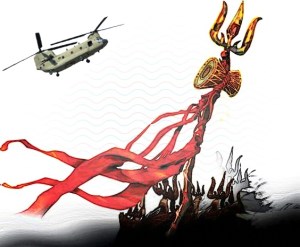
King Asilas named his most powerful weapon the Trishul after the trident once believed to be wielded by the Hindu god Shiva. Asilas and Lord Oreb originally called this weapon  the “poison filter,” which was used to simply block mysterious frequencies that contained Satanic, subliminal messages from various forms of media. These frequencies manipulated the population into accepting evil and corruption as normal and acceptable behavior. Oreb and a team of scientists discovered with tweaking the machine and making some modifications, they could not only block certain frequencies, but also reverse the effects of long term exposure to many other previously unknown frequencies which inhibited the human brain from working at full capacity. The poison filter’s original design had changed from a one-prong device to a much larger three-prong machine about the size of a small car. It could be fitted on a stealth chinook, which was Asilas’s vehicle of choice, tanks, stealth bombers, off-road vehicles and ships. However, there was only one main Trishul, and it was made to be mounted on a variety of vehicles and be deployed at a moment’s notice.


The Trishul’s range was limited to an area over land or sea and could only affect people within the radius of its transmissions. It worked much like a radio transmitter, emitting frequencies which countered other specific frequencies, allowing only natural emissions to penetrate into the human body. The Trishul worked within a 40 mile radius, like any normal radio station transmission. People could only escape this range of the Trishul in large, fortified buildings or even underground bunkers. Even if some of the wealthy and powerful managed to shield themselves from the Trishul’s emissions, millions of people in the general population could not. Therefore, when people had their “fog lifted,” they gained a heightened awareness of everything around them and used a peculiar telepathic ability to locate Satanists, who emit a specific frequency unique to only worshippers of the devil. For inexplicable reasons, people who had their fog lifted, conjured an innate urge to destroy Satanists completely.


The most frightening effects of the Trishul occurred days after the fog was lifted. People initially engaged in irresistible celebrations, dancing, singing and overall elation at their newfound understanding of the world around them. Lords Oreb and Roberts discovered in this initial “happy stage” people’s production of natural endorphins spiked, as well as other biological chemicals which caused people to literally whirl in endless carousing. However, once the elations subsided, the sinister phase of the Trishul’s effects came to light. The people changed their focus to finding those who emitted frequencies of Satanists. Some scientists on Oreb’s team discovered these subtle frequencies hidden within other body frequencies which were later isolated to further single out those with evil intentions. Once the people with these frequencies were found, even amongst themselves, they murdered them in the most horrific ways imaginable. From levitating them in the air and making them drop to their deaths, to physically ripping their arms and legs off, decapitation, hacking them to pieces, tearing their skin off with their bare hands and throwing them against walls, and smashing them to a pulp.


King Asilas instructed Lords Oreb and Roberts to manufacture smaller versions of the Trishul that could be carried in a Spartan’s backpack. These smaller units were used when Spartans secretly entered the capitals of small countries in Latin America like Colombia, Venezuela, Guyana, Ecuador, Suriname, French Guiana, Paraguay, Uruguay, and the Caribbean Islands. The larger countries were places for Oreb and the main Trishul unit. Strategically placing themselves at the center of the capitals, the elite Spartan teams changed their physical appearances to mimic the local people. Once in a secured location, they began transmitting the frequencies from their small Trishuls. Spartans were not effected by the Trishul themselves because they were implanted with nano devices which counteracted the frequencies. Every person within a 5 mile radius of the capital were effected and the Spartans remained in their places for three days before moving on to other capitals in other countries. What resulted were catastrophic revolts within every country in Central and South America until no governments were stable enough to contain the social unrest that ensued. America’s military forces arrived at these strategic times, commandeering the nation’s armies and reestablished order and announcing to all of its citizens that they were now a part of the New Kingdom of America.


While the Trishul’s main function had been blocking frequencies and unleashing long dormant brain capacity, there was one final facet: the effects of suggestibility. Once the effects of exposure to the Trishul’s direct transmissions subsided, for a short period of time, people became easily swayed to the king’s commands. Of course, the only person who truly knew the code on how to circumvent and exploit this consequence of the Trishul was King Asilas himself, and he told absolutely no one about it. In fact, when Oreb and the others discovered the anomaly that would ultimately lead them to this property of the Trishul, King Asilas told them all to ignore it and concentrate on other matters, squashing further investigation into it and protecting its secret.


However, when the Chinese leader, President Wei, and his team of scientists, discovered an antidote for the effects of the Trishul, this presented an enormous problem for the king. It meant he would have to allow Lords Oreb and Roberts to learn of the mysterious suggestibility effects of the Trishul’s use. In order to keep the Chines from completely derailing King Asilas’s plans of world conquest, he allowed Lords Oreb and Roberts, and a very select team of the New Kingdom’s top scientists, Dr. Paul Gentile and Dr. Miriam Moses, to counteract the effects of the Chinese antidote. To do this, the Americans would first need to capture a Chinese soldier or someone who had been injected with the antidote, since it was unlikely the Chinese would ever sell it -in spite of President Wei’s threats to do so. For this, King Asilas and his High Council devised a plan to corner the Chinese and trick them to inject their soldiers with the antidote -in anticipation of an attack using the Trishul- and capturing one of them to study. Only Lords Oreb and Roberts knew the truth about why this plan would be put into motion, keeping all of the other members of the High Council in the dark about the mock attack. America had to deliberately pick a fight with its only significant ally.